Trump Turns Up Pressure on Senate Over Save America Act and FISA Renewal
Trump Turns Up Pressure on Senate Over Save America Act and FISA Renewal
Election Integrity Bill, FISA Renewal, and Senate Rules Collide in High-Stakes Legislative Battle
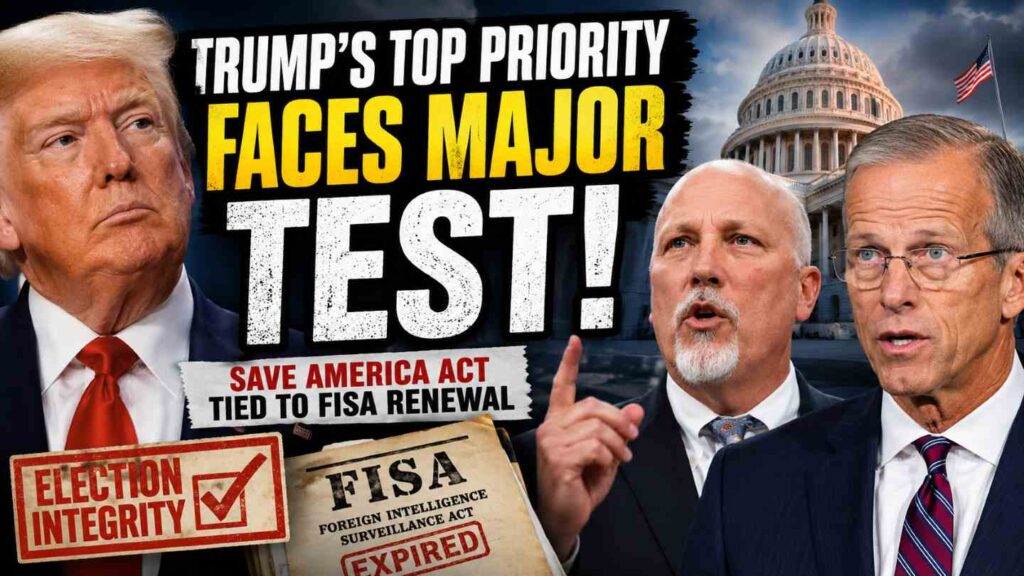
President Donald Trump’s push to pass the Save America Act has entered a critical phase as Senate Republicans face mounting pressure to advance the election integrity measure alongside a renewal of the Foreign Intelligence Surveillance Act (FISA). With legislative deadlines approaching and procedural hurdles remaining, the battle is emerging as one of the most significant tests of Trump’s congressional agenda this year.
The growing standoff has intensified after Trump signaled that he would oppose a standalone FISA extension unless it includes the Save America Act, legislation designed to require proof of citizenship for federal voting and strengthen election integrity measures nationwide.
The move has placed additional pressure on Senate Republicans as they attempt to advance key elements of the president’s agenda before Congress breaks for its summer recess.
Senate Faces Growing Pressure
Despite passing the House of Representatives multiple times, the Save America Act remains stalled in the Senate, where procedural hurdles and vote-counting challenges continue to block progress.
Senate Majority Leader John Thune recently acknowledged that Republicans face a difficult path forward, noting that the legislation currently lacks sufficient support to overcome Senate voting requirements.
Supporters of the bill argue that election integrity remains a top concern for voters and believe proof-of-citizenship requirements are widely supported by the American public. However, Senate Democrats and procedural rules have complicated efforts to move the legislation to the president’s desk.
The debate has become one of the most closely watched political battles in Washington as lawmakers weigh election security concerns against Senate traditions and legislative realities.
Chip Roy Defends Trump’s Strategy
Texas Congressman Chip Roy, the primary House sponsor of the Save America Act, praised Trump’s decision to link the legislation with FISA renewal efforts.
According to Roy, the president is using the leverage of a must-pass national security measure to force action on election-related reforms that have remained dormant in the Senate despite repeated House approval.
Roy argued that the Senate has had multiple opportunities to consider the bill and should now be compelled to address the issue directly.
The congressman also maintained that Senate Republicans possess procedural tools that could help advance the legislation if leadership chooses to pursue them aggressively.
FISA Renewal Raises Stakes
At the center of the dispute is the Foreign Intelligence Surveillance Act, commonly known as FISA, a law that provides intelligence agencies with authority to conduct surveillance related to foreign threats.
The recent lapse in FISA authority has increased urgency among lawmakers who view intelligence gathering as a critical national security function.
Some conservatives, however, are seeking additional reforms to strengthen protections against warrantless surveillance of Americans. Trump and his allies argue that combining FISA renewal with the Save America Act would address both national security and election integrity concerns simultaneously.
The proposal has helped transform the surveillance debate into a broader fight over voting laws and congressional priorities.
Filibuster Debate Returns to Center Stage
The legislative battle has also reignited debate over the Senate filibuster.
Roy and several conservative lawmakers argue that senators opposing the legislation should be required to conduct a traditional talking filibuster rather than relying on procedural mechanisms that can quietly delay legislation.
Supporters say forcing lawmakers to publicly defend their opposition would increase transparency and encourage greater accountability.
The issue is particularly significant as both parties continue to debate the future of Senate rules and whether the filibuster should remain a central feature of the legislative process.
Reconciliation 3.0 and Other Priorities
Beyond election legislation, Congress faces mounting pressure to address several major policy issues before the August recess.
Among them are defense funding, housing affordability, healthcare costs, border security, and federal spending reforms.
Lawmakers are also discussing the possibility of a third reconciliation package, often referred to as Reconciliation 3.0. The proposal could include funding for national defense initiatives while also addressing broader economic concerns affecting American families.
Roy emphasized that any future package should include spending reforms and deficit reduction measures while maintaining strong support for military readiness and border enforcement.
With only a limited number of legislative days remaining, congressional leaders face significant challenges in advancing multiple priorities simultaneously.
What Comes Next?
The weeks ahead are expected to determine whether the Save America Act can finally gain traction in the Senate or remain stalled despite continued support from House Republicans and the White House.
Trump’s decision to tie the legislation to FISA renewal has dramatically increased the political stakes and placed Senate Republicans under renewed scrutiny.
As lawmakers return to Capitol Hill, attention will focus on whether congressional leaders can bridge internal divisions, navigate Senate procedural obstacles, and deliver on one of the president’s most important legislative objectives.
The outcome could shape not only the future of election integrity legislation but also the broader direction of Trump’s domestic policy agenda in the months ahead.
#Trump #SaveAmericaAct #ElectionIntegrity #FISA #Congress #USSenate #CapitolHill #PoliticalNews #VotingLaws #NationalSecurity