Flock Safety CEO Pushes Back on Privacy Backlash as License Plate Cameras Spread Nationwide
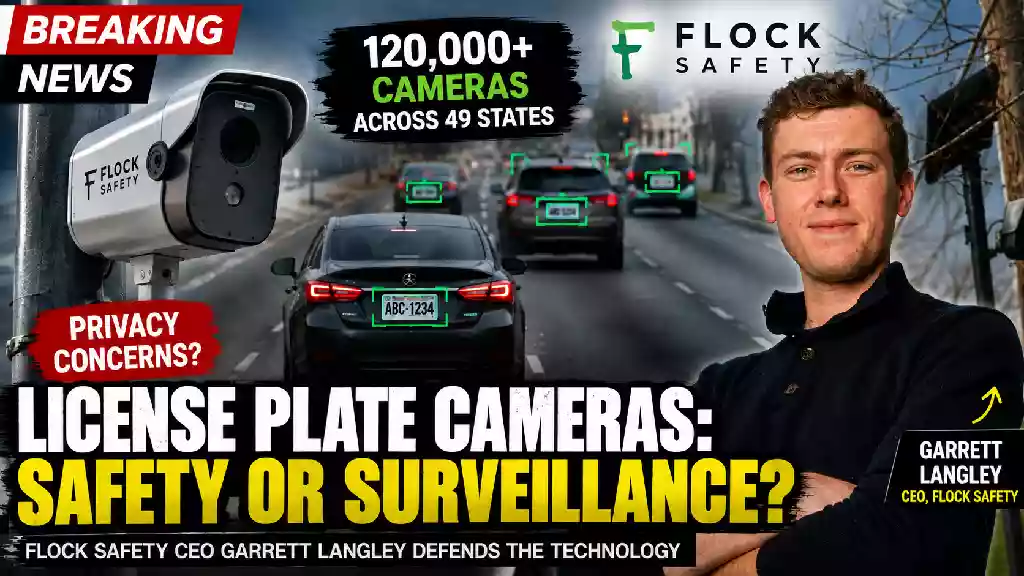
Flock Safety CEO Garrett Langley responds to growing concerns over automated license plate cameras, privacy and surveillance technology.
Flock Safety CEO Pushes Back on Privacy Backlash as License Plate Cameras Spread Nationwide
Flock Safety CEO Defends License Plate Cameras Amid Privacy and Accuracy Concerns
Flock Safety is facing growing scrutiny over the use of automated license plate recognition cameras as communities across the United States debate the balance between public safety and personal privacy. The company’s CEO, Garrett Langley, is defending the technology while responding to concerns about surveillance, inaccurate alerts and how information collected by the cameras is handled.
Flock Safety operates automated license plate reading cameras for police departments, schools and communities. According to the discussion, the company has more than 120,000 cameras operating across 49 states, putting its technology at the center of an increasingly important national debate over surveillance and law enforcement.
Flock Safety Highlights Crime-Fighting Results
Langley argued that automated license plate recognition technology is providing significant benefits to communities and law enforcement agencies.
During the interview, he said Flock Safety helped solve more than one million crimes during the previous year. He also pointed to the technology’s role in identifying stolen vehicles and locating missing people.
According to Langley, more than 1,000 missing people were detected and more than 22,000 stolen vehicles were identified during the month referenced in the interview. He presented those figures as evidence that license plate cameras can provide investigators with valuable information when time is critical.
Supporters of the technology argue that identifying vehicles can give police another investigative tool, particularly in cases involving stolen cars, missing people and criminal suspects.
Critics Warn About False Alerts
While Flock Safety emphasizes public safety, critics remain concerned about the possibility of errors.
Knox County, Tennessee Mayor Glenn Jacobs cited an incident involving a family that was stopped by police after officers believed their vehicle had been reported stolen. The vehicle was not stolen, and Jacobs said the incident was connected to an error involving Flock cameras.
Jacobs argued that the incident demonstrated the potential dangers of inaccurate license plate recognition. He also referenced a California example in which he said 71% of the hits were associated with the wrong license plate.
For critics, the concern goes beyond inconvenience. A false alert can potentially lead to an unnecessary police stop and place innocent people in a stressful or dangerous situation.
CEO Addresses Accuracy Concerns
Langley disputed the broader characterization that the technology is routinely inaccurate.
He said that for every one million alerts generated by Flock Safety, approximately eight are flagged as inaccurate. He also argued that some errors may originate from information contained in the National Crime Information Center, commonly known as NCIC.
According to Langley, inaccurate information within national databases is a problem that should be addressed. He maintained that the company is interested in improving the information used by law enforcement rather than ignoring the issue.
The conflicting perspectives illustrate one of the central challenges surrounding automated license plate readers: even highly automated systems depend on accurate information and responsible human decision-making.
Privacy Concerns Fuel the Debate
Privacy remains another major concern surrounding Flock Safety.
Residents quoted during the discussion argued that automated license plate readers can create a detailed record of where people travel. Some expressed concern that private companies are involved in technology capable of monitoring people’s movements and questioned how the information could potentially be used.
One resident described the cameras as tools that could continuously track people’s movements, raising questions about personal freedom and privacy.
These concerns reflect a broader debate over surveillance technology. While cameras can potentially help police investigate crimes, critics want safeguards to ensure that information is not misused and that innocent people’s movements are not unnecessarily monitored.
Flock Safety Rejects ‘Big Brother’ Label
Langley rejected the characterization of Flock Safety as a “Big Brother” system.
He argued that abuse of technology is unacceptable but said law-enforcement abuse existed before Flock Safety. More importantly, he maintained that Flock Safety does not sell or own the data generated by its systems.
According to Langley, customers—including businesses, communities and cities—own their data and determine how long it is stored and who it can be shared with.
That claim is central to the company’s response to concerns about data privacy and surveillance.
Public Safety vs. Personal Privacy
The controversy surrounding Flock Safety ultimately reflects a larger question facing communities across America: how should technology be used to improve public safety without undermining individual privacy?
Supporters point to stolen vehicles, missing people and criminal investigations as examples of where automated license plate readers can help. Critics, meanwhile, remain focused on false alerts, data access, surveillance and potential misuse.
Langley argued that access to effective public-safety technology should not depend on where someone lives, saying communities should receive comparable levels of protection.
As automated license plate recognition technology continues to expand, the debate over Flock Safety is likely to continue. The questions surrounding accuracy, privacy, data ownership and government access will remain critical as communities decide how much surveillance is appropriate in the name of public safety.
#FlockSafety #GarrettLangley #ALPR #LicensePlateReaders #Privacy #CivilLiberties #Surveillance #LawEnforcement #PublicSafety #DataPrivacy