Iran Defies US Sanctions as Economic Pressure Pushes Tehran Toward the Brink
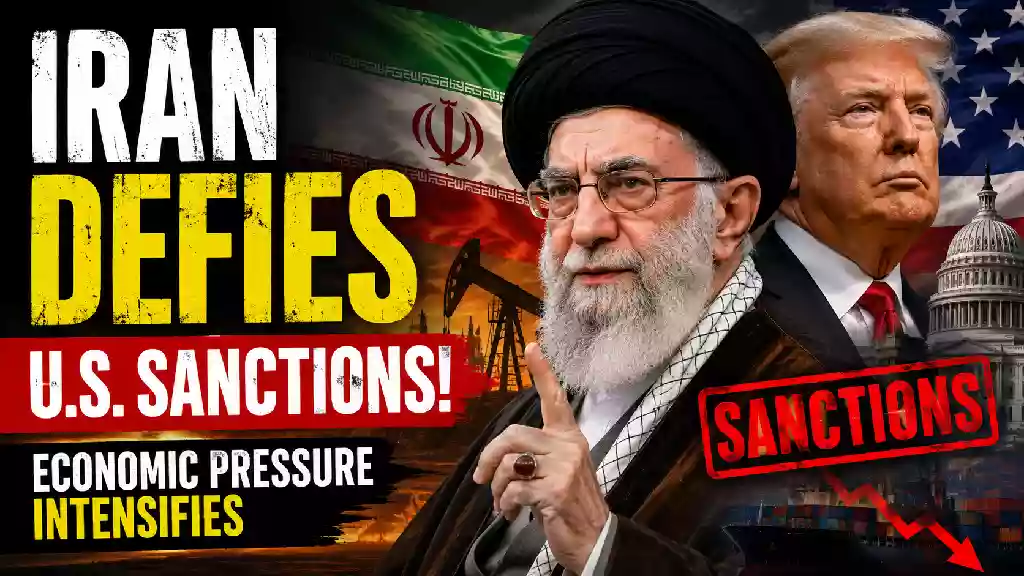
Iran faces intensifying U.S. sanctions and growing economic pressure as Tehran vows to resist Washington’s campaign. The graphic highlights Iran’s leadership, Donald Trump, oil markets, and the escalating U.S.-Iran economic confrontation.
Iran Defies US Sanctions as Economic Pressure Pushes Tehran Toward the Brink
Iran Refuses to Back Down as US Sanctions Intensify Economic Pressure
Iran is refusing to back down as the United States dramatically increases economic pressure on Tehran, putting the country’s financial system, oil trade and broader economy under growing strain.
The latest escalation comes as Washington expands its sanctions campaign and seeks greater international cooperation to isolate Iran economically. Tehran, however, says it is prepared to resist the pressure and continue relying on key international trading relationships.
The confrontation is creating a high-stakes economic battle in which the United States is attempting to squeeze Iran’s sources of revenue while Iranian officials look for ways to keep the country’s economy operating.
Iran’s Economy Under Growing Pressure
Iran’s economy is showing serious signs of stress. The report describes long lines at gas stations in Tehran and rampant inflation, highlighting the growing impact of economic instability on ordinary consumers.
The Iranian currency has also suffered significant devaluation. The report describes the exchange rate as reaching approximately two million rial to one U.S. dollar, with further weakness expected.
Despite these difficulties, Iran’s economy has not collapsed. The report describes the country as being under intense pressure but still functioning, suggesting that Tehran may be capable of absorbing additional economic pain.
That resilience could become increasingly important as Washington attempts to make the sanctions campaign more comprehensive.
Washington Targets Iran’s Financial Lifelines
The U.S. Treasury Department is expanding what has been described as Operation Economic Outcast, with efforts focused on Iranian shadow banking and other financial channels.
The broader objective is to make it harder for Iran to access international finance, conduct business and generate revenue through global markets.
For Washington, however, one of the biggest challenges is Iran’s network of international trading partners. The report identifies China, Russia, India, Turkey, Iraq, Pakistan and Qatar among Iran’s remaining major trading partners.
China is particularly significant because Beijing has indicated that it will not participate in the U.S. sanctions campaign.
China and Other Trading Partners Could Determine the Outcome
The effectiveness of the U.S. sanctions strategy may depend heavily on whether other countries continue doing business with Iran.
China remains one of Iran’s most important economic relationships, while Russia, India and Turkey also have significant connections with Tehran.
That creates a major diplomatic challenge for Washington. Sanctions can place substantial pressure on Iran, but their impact could be reduced if Tehran continues finding buyers for its oil and alternative channels for international trade.
The U.S. therefore appears to be seeking cooperation beyond its traditional allies.
G20 Diplomacy Takes Center Stage
Treasury Secretary Scott Bessent is expected to use international meetings to push other countries toward stronger restrictions on Iran.
According to the report, discussions with countries including China, Russia, India and Turkey could focus on reducing purchases of Iranian oil and limiting business relationships with Tehran.
If Washington succeeds in convincing major trading partners to reduce their economic ties with Iran, the consequences could be substantial.
But if those countries resist, Tehran could retain important economic lifelines despite the expanding American sanctions campaign.
Iran Pushes Back Against Washington
Iranian officials have responded aggressively to the pressure, accusing the United States of attempting to manipulate energy markets and influence public perceptions.
The Iranian foreign minister also criticized what Tehran described as efforts by U.S. government elements and Israel-aligned actors to promote a particular narrative surrounding the conflict.
These statements reflect the increasingly confrontational nature of the dispute. The struggle is no longer simply about financial restrictions. It also involves energy markets, international diplomacy and the wider conflict between Washington and Tehran.
Recent reporting likewise indicates that Iran has vowed to resist expanded U.S. sanctions and believes some major trading partners will refuse to join Washington’s pressure campaign.
Europe Faces Pressure to Choose Sides
The United States is also looking toward Europe for greater cooperation.
Former U.S. ambassador to the European Union Gordon Sondland argued that European nations previously faced a difficult choice over their relationships with Iran and the United States.
The report raises the possibility of broader Western coordination, including stronger economic measures involving NATO countries.
Such coordination could dramatically increase the pressure on Tehran, but it could also deepen divisions between countries that support Washington’s strategy and those determined to maintain economic ties with Iran.
A Long Economic Battle Could Be Ahead
For now, Iran appears determined to withstand the pressure rather than surrender to it.
The United States is attempting to tighten the financial screws, while Tehran is relying on international relationships and alternative economic channels to survive.
The coming weeks could therefore prove crucial. If Washington succeeds in bringing more countries into its sanctions campaign, Iran could face an even deeper economic crisis. If China, Russia and other major trading partners continue supporting economic ties with Tehran, Iran may be able to withstand another round of pressure.
Either way, the growing confrontation suggests that the battle over Iran’s economy is far from over.
#Iran #IranSanctions #USSanctions #IranEconomy #IranNews #USIran #EconomicWarfare #MiddleEast #IranCrisis #IranOil #Geopolitics