California’s Election System Faces a Growing Crisis of Confidence
California’s Election System Faces a Growing Crisis of Confidence
When Election Results Take Weeks, Voters Begin Asking Questions
Confidence in elections is one of the foundations of a healthy democracy. Whether voters support Republicans, Democrats, independents, or no political party at all, they must believe the system is fair, transparent, and accurate. That is why California’s election process is drawing increasing scrutiny from voters across the political spectrum. Following recent elections, Californians once again found themselves waiting days—and in some cases weeks—for final results. While election officials point to legal procedures designed to ensure every eligible vote is counted, critics argue the prolonged process is eroding public trust and raising legitimate questions about election administration. The issue extends beyond partisan politics. It is fundamentally about whether voters can have confidence that election systems are secure, accurate, and transparent.
Why Does California Take So Long?
One of the most common questions voters ask is simple: Why does California take significantly longer than many other states and democratic nations to count ballots?
California operates under some of the most expansive voting laws in the country. Every registered voter receives a mail ballot. Ballots postmarked by Election Day can arrive days later and still be counted. Signature verification procedures, ballot curing programs, provisional ballots, and same-day voter registration all add additional time to the process. Supporters say these policies maximize voter participation and ensure legitimate ballots are not discarded unnecessarily. Critics counter that a system taking weeks to produce final results creates uncertainty and weakens public confidence. In an era when many nations can provide election outcomes within hours, California’s lengthy counting process stands out.
Voter Roll Maintenance Remains a Key Concern
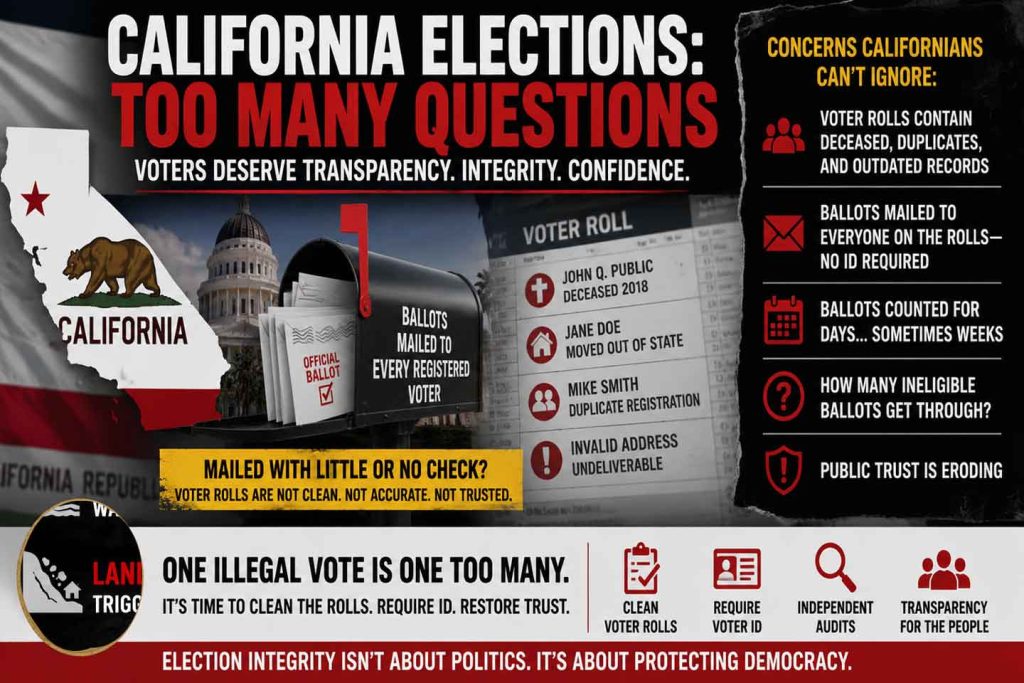
Another issue generating debate involves voter registration rolls. Election integrity advocates have repeatedly argued that voter rolls should be reviewed and updated more aggressively. Reports from election watchdog organizations have identified instances of deceased individuals, duplicate registrations, outdated addresses, and inactive voters remaining on registration lists.
It is important to distinguish between individuals remaining on voter rolls and illegal votes actually being cast. The presence of outdated registrations does not automatically mean fraudulent ballots were counted. However, many voters believe inaccurate voter rolls create vulnerabilities that should be addressed before problems occur. Election officials regularly conduct maintenance efforts, but critics argue those efforts should be expanded and made more transparent.
Organizations like the Public Interest Legal Foundation (PILF) have highlighted alarming inaccuracies in California’s voter rolls. A 2025 analysis of a sample of 2 million active registrants identified approximately 94,516 deceased individuals still listed, alongside tens of thousands of duplicates and records with placeholder or fictitious birthdates (e.g., “1/1/1900”). California maintains around 23-27 million registered voters, making these findings in a sample particularly noteworthy. Judicial Watch and others have pursued lawsuits alleging failures to remove hundreds of thousands of inactive registrations under the National Voter Registration Act (NVRA), including over 33,000 idle for five or more federal elections.
The Voter ID Debate
California is also one of several states that does not require a traditional voter ID at polling locations. Supporters of current law argue that other verification methods exist and that additional ID requirements could create barriers for eligible voters. Opponents argue that showing identification is a common requirement in everyday life and should also be required when casting a ballot.
Many Americans are surprised to learn that voter identification requirements are common in numerous democratic countries around the world. Nations such as Canada, Germany, France, Sweden, and others require some form of voter identification or registration verification before ballots are cast. As the debate continues, voter ID remains one of the most discussed election-reform proposals in California.
Public Trust Matters
Perhaps the most important issue is not whether widespread fraud has been proven. The larger issue is public confidence. An election system can only function effectively when voters believe the process is legitimate. When election results remain unresolved for weeks, voter rolls generate questions, and election procedures vary dramatically from one state to another, uncertainty naturally grows. Many Californians are asking whether the current system strikes the right balance between voter access, election security, and public confidence. Those questions deserve serious discussion rather than dismissal.
What Reforms Could Improve Confidence?
Election experts and reform advocates have proposed numerous ideas that could strengthen public trust while preserving voter access.
Among them are:
- More aggressive voter-roll maintenance programs.
- Faster ballot processing procedures.
- Increased transparency regarding outstanding ballots.
- Stronger interstate voter-roll verification systems.
- Enhanced auditing and reporting procedures.
- Greater public access to election-administration data.
- Consideration of voter identification requirements.
Supporters believe such reforms could help address concerns while maintaining access for eligible voters.
One Illegal Vote Is One Too Many
Americans will continue to disagree on election policy, just as they disagree on taxes, spending, immigration, and countless other issues.
But there is one principle many voters share:
Whether the number is ten, one hundred, or one thousand, any illegal vote is unacceptable. Election officials have a responsibility to maintain accurate voter rolls, remove deceased registrants promptly, verify voter eligibility, and ensure the public has confidence in election results. That standard should not be controversial. The goal should be simple: make it easy for every eligible citizen to vote and extremely difficult for anyone who is not eligible to cast a ballot. California’s election system may ultimately be secure. But until voters have greater confidence in the process, questions about transparency, accountability, and election administration are likely to remain part of the conversation.
Reforms for Stronger Integrity and Confidence
Targeted changes can balance access with security and trust:
- Aggressive, Transparent Roll Maintenance: Mandate regular public reporting on removal rates, sources (SSA, DMV, vital statistics), and methodologies. Fully leverage or expand interstate tools like ERIC/AVID equivalents. Pilot commercial data matching (e.g., Experian) proven in some counties. Address the 873,000+ inactive backlog promptly while protecting eligible voters.
- Faster Processing: Build on recent laws with technology investments for signature verification and pre-processing. Set clearer benchmarks for outstanding ballots and real-time transparency dashboards.
- Eligibility Verification: Strengthen beyond self-attestation where feasible (e.g., better DMV/SSN integration, SAVE for citizenship where legal). Consider non-strict voter ID options with free provision to avoid disenfranchisement.
- Oversight and Data Access: Enhance bipartisan audits, public (anonymized) roll access for watchdogs, and coordination across 58 counties and the statewide VoteCal system.
- National Alignment: Participate more fully in proven data-sharing to catch cross-state moves or deaths.
Whether the number is ten, one hundred, or one thousand, any illegal vote is unacceptable. Election officials have a responsibility to maintain accurate voter rolls, remove deceased registrants promptly, verify voter eligibility, and ensure the public has confidence in election results.
California leads in expanding voter participation. Matching that with world-class maintenance, timely results, and verifiable safeguards would set a stronger standard. Persistent questions about rolls and delays fuel cynicism not just among skeptics but across the spectrum. Reforms grounded in evidence—proactive cleaning, transparency, modernization—protect access while making abuse extremely difficult. Voters of all affiliations deserve systems that earn, rather than demand, trust. Implementing these changes would strengthen California’s democracy for future cycles.
This analysis relies on public reports, lawsuits, official data, and election administration best practices for balance.
#ElectionIntegrity #CaliforniaElections #ElectionReform #VoterID #ElectionSecurity #CaliforniaPolitics #VoterRolls #ElectionTransparency #VotingRights #Democracy #ElectionAdministration #PublicTrust #ElectionAccountability #BallotCounting #PoliticalAnalysis #CaliforniaNews
Tom Homan Warns “Justice Is Coming” for Those Funding Anti-ICE Protests