China’s Pressure on Philippines Signals Wider Indo-Pacific Power Struggle Expert Warns
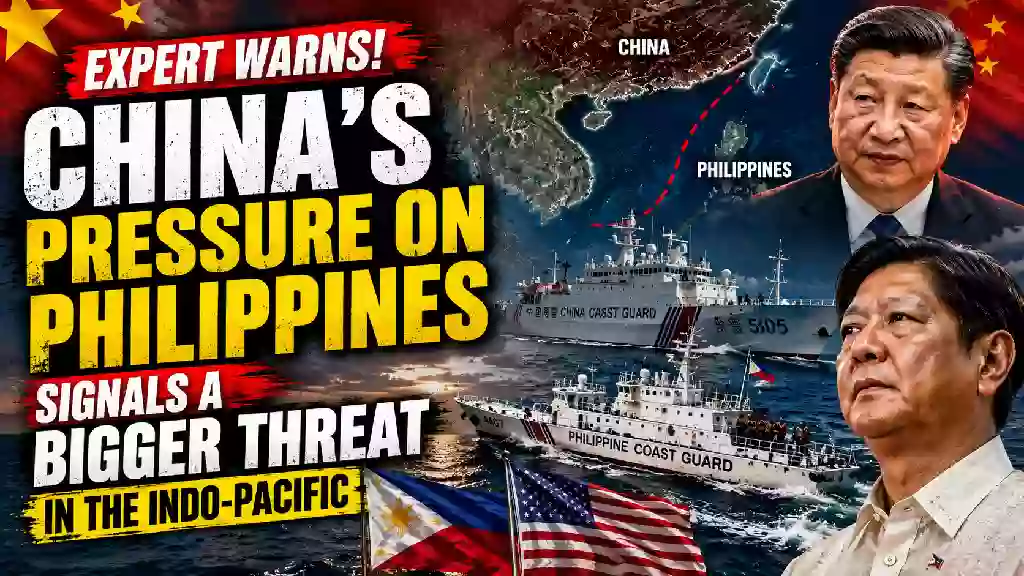
China’s growing pressure on the Philippines is raising broader concerns about security, freedom of navigation and the balance of power in the Indo-Pacific, according to national security expert Steve Yates.
China’s Pressure on Philippines Signals Wider Indo-Pacific Power Struggle Expert Warns
Philippines Emerges as Key Flashpoint in Growing China-US Rivalry
Concerns over China’s growing pressure on the Philippines are highlighting a much larger strategic struggle unfolding across the Indo-Pacific, according to national security expert Steve Yates.
Yates, a Heritage senior research fellow, argued that China’s actions toward the Philippines demonstrate that Beijing’s ambitions should not be viewed solely through the lens of Taiwan. Instead, the growing tensions point to a broader contest involving freedom of navigation, regional security and the competing visions for Asia’s future.
The Philippines has increasingly become an important part of the strategic equation in the Indo-Pacific, particularly as the United States and its regional partners seek to maintain a strong position along the first island chain. Yates said recent developments have caused the Philippines to become more aware of the broader implications of China’s actions.
China-Philippines Tensions Take on Greater Significance
The source’s discussion places the Philippines within a much wider geopolitical competition. While Taiwan remains one of the most closely watched potential flashpoints in Asia, Yates argued that China’s pressure on the Philippines makes clear that the stakes extend beyond the island.
According to Yates, the issue involves fundamental questions about freedom of navigation and the ability of people and nations throughout Asia to determine their own future.
That assessment gives the Philippines a potentially greater role in the evolving U.S.-China rivalry. Developments involving the country could affect how Washington and its allies approach regional deterrence, military cooperation and security planning.
First Island Chain Becomes Increasingly Important
The first island chain remains a central element in the strategic balance of the Indo-Pacific. Yates said the United States is in a stronger position along the chain than it has been in decades, while Japan is taking a more serious approach to investment in advanced technology.
The Philippines is also becoming more significant as regional security concerns increase. Yates pointed to the country’s changing assessment of China as evidence that attitudes in the region are shifting.
For the United States and its allies, maintaining strong partnerships throughout the region could become increasingly important as competition with China develops.
U.S. Military Readiness Adds Another Layer
The discussion also comes amid questions about U.S. ammunition stockpiles following military operations involving Iran.
Some analysts have raised concerns that depleted U.S. munitions could influence China’s calculations. Gordon Chang suggested that some observers could view American weapons shortages as an opportunity for Beijing to consider military action involving Taiwan.
However, Chang also argued that China’s military is not currently prepared to invade Taiwan and suggested that a conflict involving China could eventually draw in multiple regional powers.
Yates offered a more measured view of the ammunition issue. He argued that weapons needed for operations in the Middle East are substantially different from those that would be required for a conflict in Asia because of differences in geography, distances, allies and military capabilities.
Regional Conflict Could Have Global Consequences
The possibility of a wider conflict remains one of the most significant concerns raised in the discussion.
Chang warned that a Chinese conflict could potentially involve other major powers, including Russia, North Korea, Japan, Australia and the United States. In that scenario, an East Asian conflict could become part of a much broader global confrontation.
That possibility makes developments involving the Philippines particularly important. Any significant escalation in the region could place additional pressure on U.S. alliances and force governments to reassess their military and diplomatic strategies.
Freedom of Navigation at the Heart of the Dispute
For Yates, the central issue is ultimately larger than Taiwan or Chinese domestic politics.
He argued that China’s pressure on the Philippines demonstrates that the broader struggle concerns freedom of navigation, freedom for people across Asia and the competing models of development available to countries in the region.
That perspective places the Philippines firmly within the wider Indo-Pacific security debate. As the United States, Japan and other regional partners strengthen their capabilities and relationships, the Philippines could remain an increasingly important part of the region’s strategic landscape.
For now, the developments underscore the complexity of the U.S.-China rivalry. What happens around the Philippines may ultimately have implications far beyond its immediate waters, shaping the broader debate over security, sovereignty and freedom of navigation across the Indo-Pacific.
#China #Philippines #IndoPacific #ChinaPhilippines #Taiwan #USChina #NationalSecurity #FreedomOfNavigation #Geopolitics #AsiaPacific