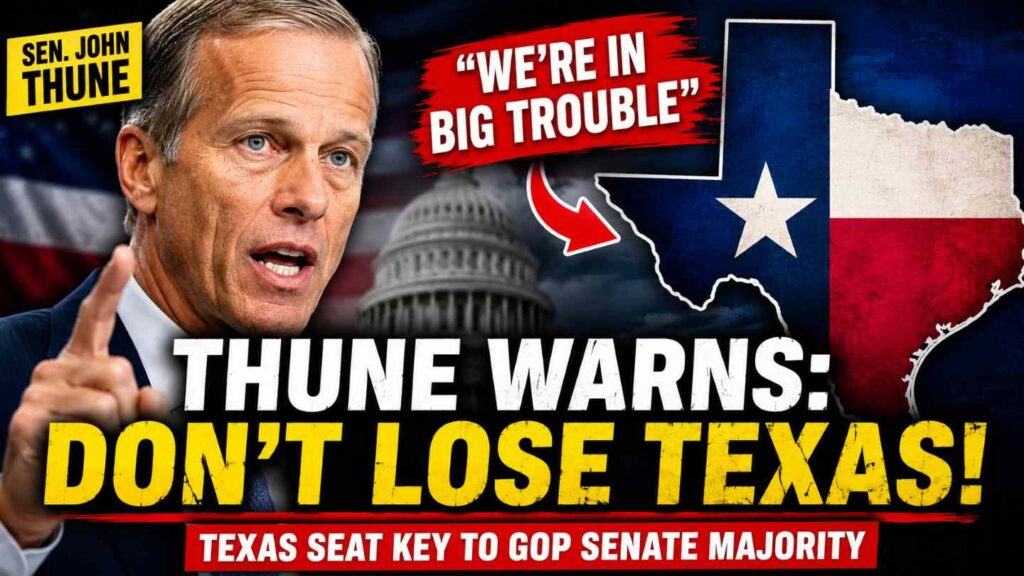
Thune Warns GOP Could Be ‘In Big Trouble if Texas Senate Seat Is Lost
Thune Warns GOP Could Be ‘In Big Trouble if Texas Senate Seat Is Lost
Senate Majority Leader Says Texas Race Is Critical to Republican Control
Senate Majority Leader John Thune is warning Republicans that maintaining control of Texas could be essential to preserving the party’s majority in the U.S. Senate, calling the state one of the most important battlegrounds for the GOP’s political future.
Speaking during an interview on Fox Business’ “Mornings with Maria,” Thune discussed the upcoming Texas Senate race, challenges facing President Donald Trump’s legislative agenda, and ongoing debates over national security legislation.
The South Dakota Republican said Texas remains a cornerstone of Republican strength and warned that losing the seat could have major consequences for the party’s ability to maintain influence in Washington.
“If we lose Texas, we’re in big trouble,” Thune said during the interview.
Republicans Rally Behind Paxton
The comments came as Republicans continue to unify behind Texas Attorney General Ken Paxton following his emergence as the party’s preferred candidate in the race.
Thune acknowledged that he had previously supported Senator John Cornyn during the Republican primary process and had discussed the race with President Trump. However, he emphasized that Republicans are now focused on maintaining the seat regardless of the primary outcome.
According to Thune, keeping Texas in Republican hands is vital to preserving the party’s Senate majority and advancing conservative policy priorities.
Political analysts have long viewed Texas as a key state in national elections due to its size, economic influence, and growing population. While Republicans have maintained statewide success in recent years, demographic shifts and increased political competition have drawn significant national attention to future races in the state.
Senate Math Continues to Shape Legislative Battles
Beyond the Texas race, Thune addressed criticism from some conservatives who argue the Senate has not moved quickly enough on several priorities supported by President Trump.
Thune said legislative delays are often the result of Senate procedures and vote counts rather than a lack of commitment to advancing Republican policies.
“It’s a function of math,” Thune explained, noting that Senate leaders must secure enough support before bringing major legislation to the floor.
The Senate’s rules require bipartisan cooperation on many issues, particularly legislation that must overcome the chamber’s 60-vote threshold. While Republicans hold a majority, they do not possess enough votes to advance many measures without support from at least some Democrats.
Thune indicated that Senate leadership must carefully evaluate whether legislation has a realistic path to passage before scheduling floor votes.
Debate Continues Over Election Legislation
The interview also touched on election-related proposals supported by many Republicans, including measures involving voter identification requirements and proof-of-citizenship provisions.
Supporters argue such measures help strengthen election integrity and public confidence in the voting process. Opponents contend that some proposals could create unnecessary barriers for eligible voters and limit access to the ballot box.
Thune said many Republican-backed election security measures remain popular among GOP voters, but acknowledged that Democrats have generally opposed those efforts in the Senate.
The issue remains one of the most debated topics in national politics as lawmakers continue discussing how to balance election security with voter accessibility.
National Security Debate Centers on FISA
Another significant issue discussed during the interview involved Section 702 of the Foreign Intelligence Surveillance Act, commonly known as FISA.
Congress recently failed to advance legislation reauthorizing the intelligence program before a key deadline. The law allows U.S. intelligence agencies to collect communications involving foreign targets located outside the United States.
Supporters describe the program as a valuable national security tool used to monitor foreign threats and gather intelligence. Critics, including civil liberties advocates and some lawmakers from both parties, have raised concerns about privacy protections and the incidental collection of communications involving Americans.
The debate has intensified amid broader disagreements over intelligence leadership and national security policy.
Thune argued that maintaining effective intelligence capabilities remains essential to protecting the country from terrorism, foreign adversaries, and other security threats.
Looking Ahead
As Congress returns to debates over election legislation, national security programs, federal spending, and President Trump’s policy agenda, Republican leaders continue balancing legislative priorities with political realities.
For Thune, however, one message stood out above the rest: maintaining Republican control of Texas remains a critical component of the party’s strategy moving forward.
With control of the Senate often decided by a handful of competitive races, the outcome in Texas could play a major role in shaping the balance of power in Washington for years to come.
#JohnThune #TexasPolitics #KenPaxton #USSenate #Republicans #Election2026 #Politics #Congress #NationalSecurity #FISA